


-
Why I Sometimes Need Support With the “Simple” Thing
I have a love-hate relationship with the word independence. I know what independence looks like for a lot of people, or at least what it is considered to look like in this world. I look around and see people who are independent, and sometimes I envy them. I find myself jealous because I want...
-
Does Movement Help Autistic Children Learn? What the Research Tells Us
"Sit still, focus, pay attention." We hear these familiar reminders at home, in the classroom, during homework, and even at social gatherings. But does a child really need to sit still to learn? Could making room for movement help? For parents and educators supporting autistic and other...
-
The Sound in the Corridor: The Science of Regulation
There are sounds that remain with you long after they fade. Not because they were loud, but because they were unanswered. It was the morning before a Parent-Teacher Meeting at Addwik's special school in Jaipur. The building was already awake. Chairs were being arranged. Files were stacked neatly....
-
The Long Nights: Rebuilding Routines After Jaipur
Jaipur did not feel like an ending. It felt like a checkpoint. When I got posted to Jaipur Military Station in December 2023, we had already lived through thirteen years of vast experience. My first book, Autism and Me, had traced that journey — from denial to diagnosis, from confusion to...
-
Practice Before the Night: A Halloween Plan for Families of Children with Autism and Sensory Differences
Halloween falls on Saturday this year, which means families still have time for a practice run at their own front door. Starting now gives parents of kids with autism, ADHD, or sensory differences time to address the parts that usually go wrong. Meaghan Timko, MS, BCBA, Advisor on Behavior...
-
Autism Is Genetic. It’s Time Society Caught up With the Evidence
For decades autistic people have had to listen to other people debate what supposedly made us autistic. Vaccines have probably been one of the most persistent claims, despite this question being researched repeatedly over many years. I really hope we are finally reaching a point where this...
-
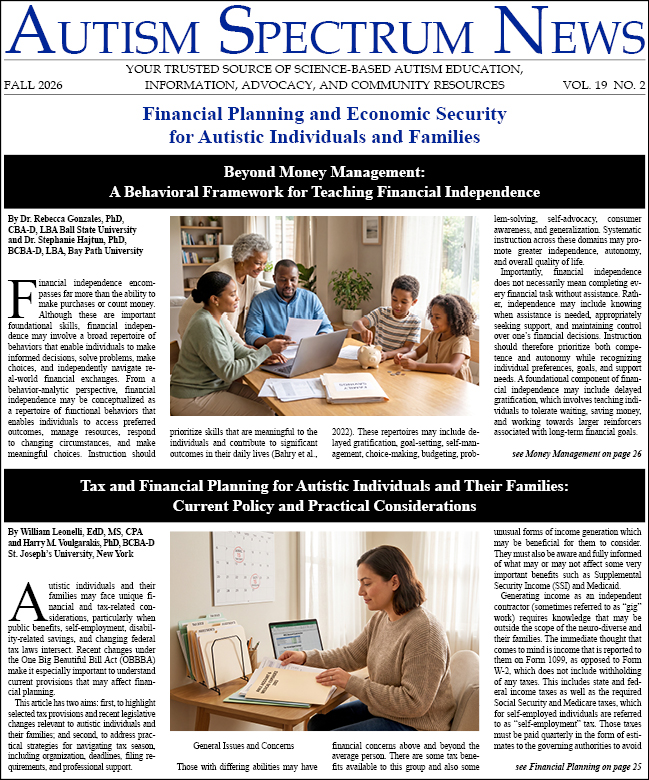
Beyond Money Management: A Behavioral Framework for Teaching Financial Independence
Financial independence encompasses far more than the ability to make purchases or count money. Although these are important foundational skills, financial independence may involve a broad repertoire of behaviors that enable individuals to make informed decisions, solve problems, make choices, and...
-
Tax and Financial Planning for Autistic Individuals and Their Families: Current Policy and Practical Considerations
Autistic individuals and their families may face unique financial and tax-related considerations, particularly when public benefits, self-employment, disability-related savings, and changing federal tax laws intersect. Recent changes under the One Big Beautiful Bill Act (OBBBA) make it especially...
-
Financial Awareness for Autistic Individuals: A Practical Guide to Safer Digital Participation
Shortly before Christmas 2022, I needed extra cash. I owned a varsity football jacket that I seldom wore and posted it for sale on Facebook Marketplace. My ad received little attention, until December 24th when someone inquired about it. He needed a last-minute gift for a friend he was going...
-
The Right to the Ordinary: Money, Choice, and Dignity for Autistic Adults
Andrew recently spent a night in New York City. It was a staycation — a Broadway show, dinner in Manhattan, an overnight stay at a Times Square hotel, and shopping for souvenirs. Andrew is a young autistic man supported by AABR, and during this particular trip, something new was in his...
-
Building a Neuro-Inclusive Housing Market: The Evidence and a Case for Action
Adults with autism and/or intellectual/developmental disabilities (I/DD), including those with profound autism, are a growing population with well-documented housing needs.1,2 Despite decades of deinstitutionalization and investment in community-based services, a purpose-built housing market has...
-
Rethinking Healthcare for Adults With Autism And/or Intellectual/Developmental Disabilities (I/DD)
For many adults with autism and/or I/DD, receiving healthcare can involve more than making an appointment and seeing a doctor. There is getting to the appointment, navigating insurance, waiting in an unfamiliar or overwhelming environment, communicating symptoms and concerns, understanding what...
-
From High School to Life After School: Supporting Communication, Problem Solving, and Self-Advocacy in Autistic Students
The transition from high school to the "real world" is often challenging and stressful for many young adults. This period involves a dramatic shift in expectations and experiences related to college and postsecondary education, employment, friendships and romantic relationships, independent living,...
-
Building Financial Autonomy While Guarding Against Exploitation: Practical Tools for Autistic and I/DD Adults and Families
Financial security is one of the most critical, yet frequently overlooked, competencies of independent living for autistic individuals and those with Intellectual or Developmental Disabilities (I/DD). As young adults transition out of secondary education and into adult services, conversations...
-
The Path to Economic Security: How Job Coaching Builds Financial Independence for Autistic People
Financial planning conversations for autistic people and families often start in an unexpected place: not a bank or a budgeting app, but a job. Research shows just how much is riding on that starting point. A study from Drexel University's A.J. Drexel Autism Institute found that autistic young...
-
Adulthood Isn’t a Birthday: The Systems That Make Financial Autonomy Possible for Autistic Adults
I became a legal adult on a birthday. Financial autonomy took longer. Those two things are constantly treated as though they happen at the same moment. At eighteen, the law can recognize a person as capable of signing contracts, opening accounts, consenting to services, travelling, working,...
-
Scams, Spending, and Special Interests: One Autistic Adult’s Guide to Financial Independence
I will begin by making a few important disclaimers. First of all, I have no formal education or background in financial matters. Anything that I discuss is strictly from the perspective of my own personal experiences and an appreciation of the concerns and challenges presented by living on the...
-
A First in American History: What the Education Freedom Tax Credit Could Unlock for Autism Families
Meet Ryan. He and his family had a waitlist letter for an evaluation for augmentative communication, with an opening that didn't come for seven months. When that moment finally came, the communication device he needed cost over $750, and insurance covered none of it, claiming it wasn't...
-
Plan for a Lifetime: How to Build Financial Security for an Autistic Person
There is no one-size-fits-all approach to financial planning. Every person and family brings different goals, resources, responsibilities, and ideas about what financial security looks like. That is especially true when planning for or alongside a loved one on the autism spectrum. For an...
-
Financial Independence Starts With Daily Living Skills
When families think about financial independence, the conversation often begins with money—budgeting, saving, earning a paycheck, opening a bank account, and learning how to pay bills. These are important skills, but for many autistic individuals, the foundation for financial independence begins...
-
Financial Systems Are Accessibility Tools: Building a Business That Doesn’t Depend on Your Best Day
During the worst period of my life, I learned that a business can either become one more thing its owner has to hold together, or it can be built to help hold them. My mom went into the hospital on October 5. Nine days later, she died. I'd been there every day, and I was there when she went into...
-
Financial Planning for an Autistic Child When Parents Divorce
Many families with a child on the autism spectrum face divorce. One of the biggest concerns in these divorces is what will happen to the children. Parents may worry about how to explain divorce to an autistic child, provide emotional support and reassurance during the process, and ease transitions...
-
Beyond Money Math: Using THINK to Teach Financial Literacy to Autistic Teens
Managing money well is an essential skill that influences independence and quality of life. As financial expert Dave Ramsey said, "You must gain control over your money or the lack of it will forever control you." Money management is essentially mathematical skills combined with self-control and...
-
The Unfinished Business of the ADA: Financial Security for People With Disabilities
On July 26, 2026, the 36th anniversary of the Americans with Disabilities Act (ADA), the National Council on Disability (NCD) announced the "Plan for Disability Middle Class Framework." The NCD is the independent federal agency that first recommended the creation of an ADA and wrote the initial...
-
Planning for a Lifetime: Building a More Secure Future for Autistic People and Their Families
When my son AJ was diagnosed with autism at age three, my wife and I focused on what was immediately in front of us: signing him up for the right therapies, navigating IEP meetings, finding activities he enjoyed, and helping him build skills. Like many parents, we were thinking about his future,...
-
Supporting Financial Literacy in Autistic Adults Through Neurodiversity-Affirming Life Coaching
Why Is Financial Literacy Important? Financial literacy, or the ability to understand and use personal finance skills effectively, can be a key factor in improving quality of life for many autistic adults. The ability to earn, save, manage spending, and avoid debt can significantly improve...
-
Don’t Give Up: Lessons From My Decade on Social Security Disability
My name is Katherine and I am 37 years old. I have been receiving Social Security Disability and Medicare for the past ten years. I have a learning disorder, autism, mental health issues, and a host of physical conditions making it impossible to work outside the home. It was not an easy...
-
Autistic Personal Philosophy: Regarding Equity and Equality
Both of these terms are of critical importance to the establishment and enforcement of those rules, regulations, and laws of ours with social justice implications, though one of them often wins out when the other should. The consequences, particularly for members of marginalized segments of the...
-
Medicaid Fraud Is Real. So Is the Harm to Families Who Depend on It
Reports of Medicaid fraud are deeply troubling, and those responsible should be prosecuted. But fraud has become the justification for policies that make it harder for families to access the medical care and supports they depend on. Our government has the tools to investigate fraud without placing...
-
The Person Doesn’t Change. The System Around Them Does.
At UCLA's PEERS Clinic, I coached autistic teenagers learning social skills that could help them navigate adulthood. Later, as a behavioral therapist, I worked directly with autistic individuals and their families in their homes. One mother stopped me after a session. Her daughter had just...
-
Profiling Neurodiverse Hiring Initiatives and What They Actually Deliver
About 15% to 20% of the global population identifies as neurodivergent, yet these same individuals experience significant employment disparities and unemployment rates ranging from 30% to 85%. Today, a lot of the conversation around employment is one-directional. Prospective employees are more...
-
The Financial Side of an Autism Diagnosis: What Families Should Know
Receiving an autism diagnosis for your child may bring an overwhelming amount of new information. Families quickly find themselves learning about therapeutic recommendations such as Applied Behavior Analysis (ABA), speech-language therapy, occupational therapy, and additional medical care. ABA, for...
-
Life Through an Autistic Lens: My Fear of Growing Old Without Financial Stability
I deeply feel time speeding by. The years speeding by. And it viscerally terrifies me. Because with each passing day, my fear over my future grows. It gets increasingly real. At the heart of my fear is this one question: Will I have enough money to be able to live independently for as...
-
Tips for Planning Financial Security Beyond Childhood
The financial systems that support a child mostly disappear at eighteen. Here's how families can plan for the system that replaces them. Most of the financial planning conversations that happen in early intervention and school-age ABA services are, understandably, focused on the here and now:...
-
Financial Mistakes Parents of Children With Autism Should Avoid
The financial side of an autism diagnosis often catches parents off guard just as much as the clinical side. Here are six mistakes to avoid. Clinical directors and Board-Certified Behavior Analysts sit across the table from families every week during intake meetings, treatment plan reviews, and...